
- If Netflix keeps buffering while other apps work fine, check if it affects only certain movies, devices, or networks, and try different combinations to pinpoint the problem.
- Testing your internet connection specifically for Netflix using fast.com, trying Ethernet cables, and reducing streaming quality can help improve performance.
- Restarting apps, devices, routers, and modems can reset connections, while pausing heavy downloads and updating software or clearing app storage may resolve buffering issues.
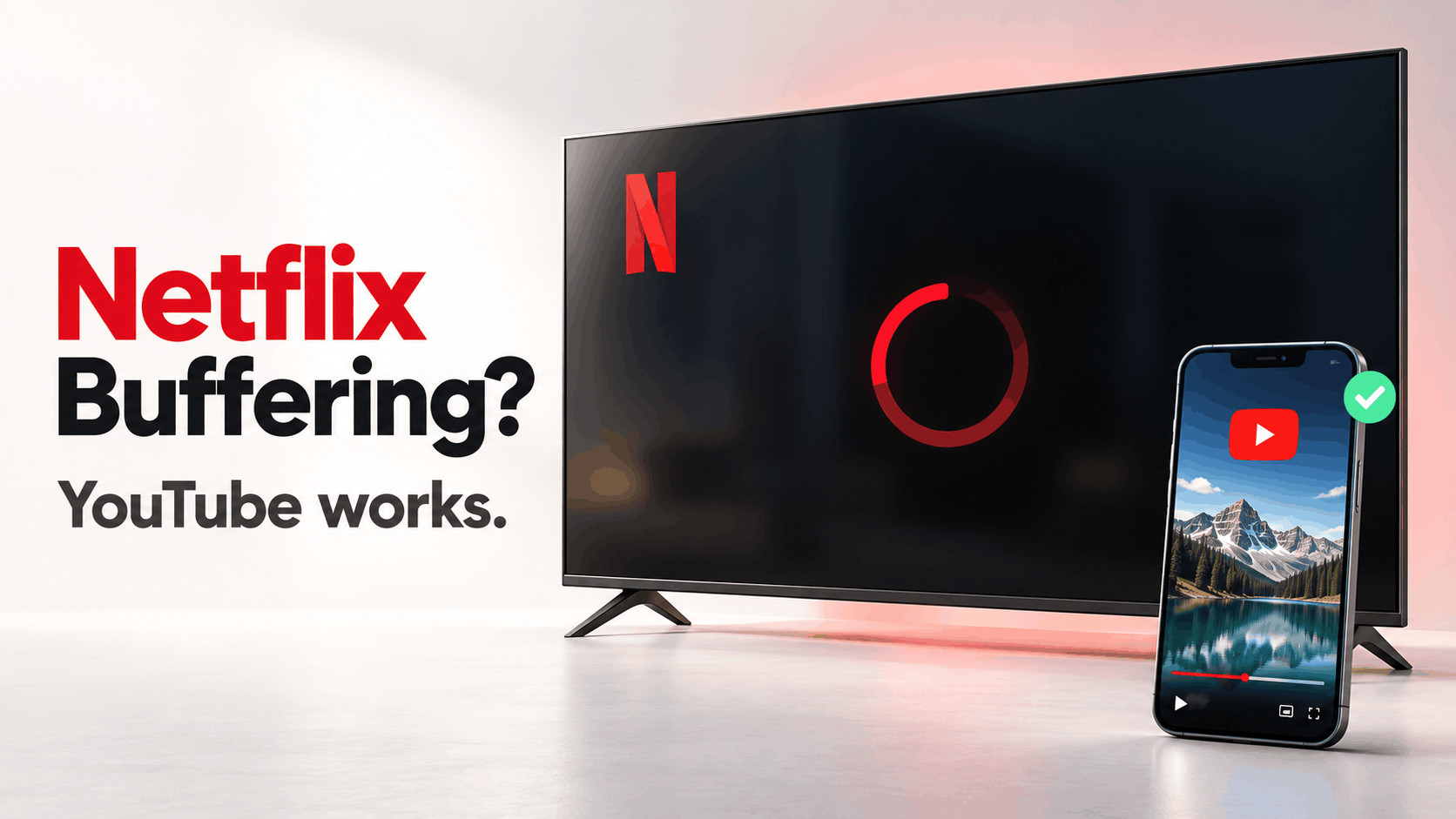
YouTube plays smoothly, other streaming apps open normally, but Netflix keeps stopping to load. It is tempting to blame Netflix immediately, especially when an internet speed test shows a fast connection.
However, working apps do not rule out a network problem. Netflix may be affected by a different delivery route, unstable Wi-Fi, its playback settings, or a problem with the app itself. The checks below help you identify which part needs attention.
Why Does Netflix Buffer When Other Apps Work?
Buffering happens when Netflix cannot receive enough video data to keep playback going. Your device temporarily pauses while it downloads more of the movie or episode.
Netflix and YouTube use different delivery systems, so congestion affecting one service might leave another working normally. Their video quality can also differ: a YouTube video playing at 720p is not a reliable comparison with Netflix streaming in 4K.
Also, a speed test measures performance at a particular moment. A high result cannot guarantee that the connection remains stable throughout an episode. If Netflix’s menus stop responding too, investigate an app freeze rather than treating every loading screen as buffering.
Start by Identifying Where the Problem Happens
Before changing settings, compare Netflix across titles, devices, and networks. Keep the same movie or episode for device and network comparisons so the results are easier to interpret.
- Only one title fails: Try another episode and an unrelated movie.
- Only one device buffers: Focus on that device’s app, software, and connection.
- Several devices buffer on home Wi-Fi: Investigate the router or internet connection.
- The same device works on another network: Your home network or provider deserves closer attention.
These results narrow the search, but they do not prove a specific cause. For example, a successful hotspot test cannot establish that your provider deliberately slows Netflix.
How to Fix Netflix Buffering When YouTube Works
1. Check Netflix’s Service Status and Another Title
Open Netflix’s Help Center and check its “Is Netflix Down?” page. If Netflix reports a streaming interruption, wait for service to recover before changing your device settings.
If there is no reported outage, play two or three unrelated titles. When only one movie or episode fails repeatedly, use the profile’s Viewing Activity in a browser and select Report a Problem beside that title. A clear status page does not rule out every local or title-specific issue.
2. Test Your Connection to Netflix
Use fast.com on the affected device if it has a browser. On supported TVs and streaming devices, open Netflix’s menu, choose Get Help, then Check your Network; some versions place this under Settings.
Netflix currently recommends a stable connection of:
- 720p HD: 3 Mbps or higher.
- 1080p Full HD: 5 Mbps or higher.
- 4K Ultra HD: 15 Mbps or higher.
Repeat the test while buffering occurs. A phone’s result beside the router does not tell you how well a TV receives Wi-Fi in another room, and other household activity can reduce the bandwidth available for playback.
3. Restart the App and Streaming Device
Close Netflix completely and reopen it. If buffering continues, restart your phone, computer, TV, or streaming player to refresh its running software.
- For a TV or streaming device, unplug it from power.
- Leave it unplugged for three minutes.
- Reconnect it, open Netflix, and replay the same title.
Turning a TV off with its remote may only put it in standby. A complete restart is more useful when the app has been running for days or became unreliable after an update.
4. Restart Your Router and Modem
A router can still provide internet access while a connection problem disrupts streaming. Restarting your home network gives its equipment a fresh connection.
- Unplug the router and modem from power for 30 seconds.
- Reconnect the modem first and wait for its connection lights to settle.
- Reconnect the separate router, wait for Wi-Fi to return, and test Netflix.
If you have one combined unit, restart that unit. Use the power connection, not the factory-reset button, which can erase your network settings.
5. Compare Wi-Fi with Ethernet
If your TV or streaming player supports Ethernet, connect it to the router with a network cable. Replay the title long enough to see whether the usual buffering returns.
If Ethernet helps, that points toward the wireless connection. Move the router closer, place it in an open position, and reduce obstacles between it and the device.
Where available, compare the router’s 2.4 GHz and 5 GHz networks. The better choice depends on distance and walls, so use playback results rather than assuming one band always wins.
6. Lower Netflix’s Playback Quality Temporarily
Lower quality reduces the amount of data needed for playback. This is useful when Netflix buffers during higher-quality streams or when several people share the connection.
- Sign in to Netflix through a browser and open Account.
- Select Profiles and choose the affected profile.
- Open Playback settings.
- Change High to Auto, or try Medium as a temporary test.
Reopen playback and compare the result. Medium reduces picture quality, so restore your preferred setting after resolving the connection problem. Lowering quality can relieve buffering without fixing its underlying cause.
7. Pause Heavy Downloads and Uploads
Pause game updates, cloud backups, large downloads, and other video streams while testing Netflix. Devices elsewhere in the house may be using bandwidth even when nobody is actively watching them.
If Netflix becomes reliable, restart those activities individually to identify what affects playback. Scheduling large transfers outside viewing hours may be enough, without paying for a faster internet plan.
8. Update Netflix and Your Device Software
Open your device’s official app store and install any available Netflix update. Then check the device’s settings for operating-system or firmware updates.
On TVs, the Netflix app may update through the manufacturer’s app system or device software. Install updates using the instructions for your model, restart afterward, and test again. This addresses outdated software that network changes cannot repair.
9. Refresh Netflix’s Stored Data
If only one device is affected, sign out of Netflix and sign back in. Have your login details ready before starting.
- Android: Open Netflix’s App info, then Storage & cache. Clear cache first if available; use Clear storage or Clear data only if needed.
- iPhone or iPad: If restarting and updating fail, delete Netflix and reinstall it from the App Store.
- Computer browser: Visit netflix.com/clearcookies, then sign in again.
Clearing app storage or deleting Netflix removes downloaded shows and signs you out. Menu names vary, and some TVs do not offer a separate cache-clearing option.
10. Test Without VPNs or Browser Extensions
If you use a VPN or proxy, disconnect it temporarily and test Netflix again. If you recently changed custom DNS settings, record them before restoring the device’s automatic settings.
For browser playback, update the browser and temporarily disable extensions that modify videos, block content, or route traffic. If playback improves, re-enable extensions individually to identify the cause. Treat these changes as diagnostic tests rather than guaranteed speed improvements.
Common Buffering Patterns and What to Do Next
Netflix buffers mainly in the evening: Repeat the connection test at that time and during quieter hours. A consistent difference suggests congestion, but additional testing is needed to identify where it occurs.
Netflix works on mobile data but not home Wi-Fi: Give your provider the affected device, test results, and times. Ask them to investigate connectivity to Netflix; hotspot success alone does not prove throttling.
Netflix fails on one device across different networks: Contact Netflix support with the device model, software version, and any error code. Avoid a factory reset until support or the manufacturer recommends it.
Frequently Asked Questions
Why Does Netflix Buffer with Fast Internet?
Your plan’s advertised speed is not the same as sustained performance on your streaming device. Weak Wi-Fi, shared bandwidth, a Netflix connection issue, or outdated software can still interrupt playback.
Does Changing DNS Stop Netflix Buffering?
It may help when a DNS problem prevents Netflix from connecting properly. It does not automatically increase bandwidth or repair weak Wi-Fi, so random DNS changes are not a dependable buffering fix.
Should I Upgrade My Netflix Plan?
A plan upgrade does not repair an unstable connection or app problem. Troubleshoot the existing setup first, especially if Netflix previously worked reliably on the same device.
Can Reinstalling Netflix Fix Buffering?
It can help when the problem comes from the app’s stored data or installation. It is less likely to help when several devices buffer on the same network, and it removes local downloads.
Final Thoughts
When Netflix keeps buffering but YouTube and other apps work, compare titles, devices, and networks before making major changes. Test Netflix’s connection, restart the equipment, and check whether Ethernet or lower playback quality helps.
Those comparisons give Netflix support or your provider useful evidence if the problem continues. Change one setting at a time so you can identify which action actually restores reliable playback. Keep notes of each result, including whether buffering stopped completely or simply happened less often afterward.